MPhil/PhD in Environmental Health
Admission criteria
Candidates seeking admission to the first year of the PhD in Environmental Health must hold a Master’s degree in Environmental Health or a related field. Those applying for MPhil should have a Bachelor of Science Degree or any related field with experience in conducting independent research. Additional admission requirements are outlined in the GPRH or the advertisement for postgraduate programs at MUBAS.
Programme structure
The PhD is awarded to scholars who have conducted supervised, original research that is deemed to have made a significant contribution to the field of environmental health. This program is fully research-based. All students are enrolled in the PhD program from the first year and are assigned both a primary and secondary supervisor, with the division of responsibilities outlined in the Postgraduate Handbook. In the first year, students may audit certain modules, including Research Methodology at the Master’s level, to earn 60 credits for academic enrichment, which can assist in proposal development and the research process. The thesis itself contributes 360 credits toward the PhD in Environmental Health. The key stages of the research project are illustrated in Figure 1.
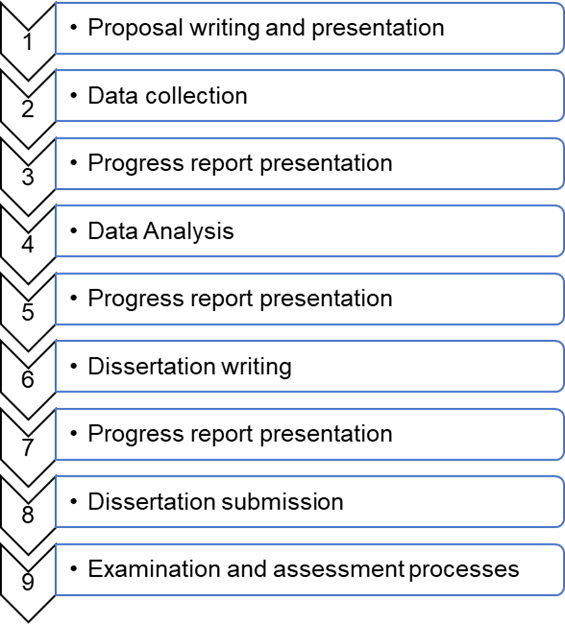
Figure 1: Research Project Stages
Preparation for the Dissertation
Students are required to take Research Methodology in their first year to prepare for their research work. The concepts learned in this course lead to the development of a research proposal, which must be defended before data collection begins. For detailed guidelines on dissertation preparation, please refer to the Postgraduate Handbook.
Programme exits
Upon successful completion of the program, students will be awarded a PhD in Environmental Health. To earn the degree, a candidate must accumulate a total of 360 credits. If a candidate is unable to satisfactorily complete the PhD requirements for any reason, they may be awarded an MPhil in Environmental Health, provided they meet the conditions for that award.
Bachelor of Science in Environmental Health
Programme Structure
Normal Entry
A candidate with MSCE, ‘O’ Level or equivalent may join the programme at the beginning year 1. The candidate must have at leasr six credits including English, Mathematics, Biology, Physics and Chemistry.
Mature Entry
- A candidate with MSCE, ‘O’ Level or equivalent, field work experience and a relevant qualification from a recognized institution, may join the programme at the beginning of year 2 (Semester 1).
- A candidate with MSCE, ‘O’ Level or equivalent, field work experience and a diploma in Public Health obtained from MUBAS or similar qualification from recognized institution, may join the programme at the beginning of year 3 (Semester 1).
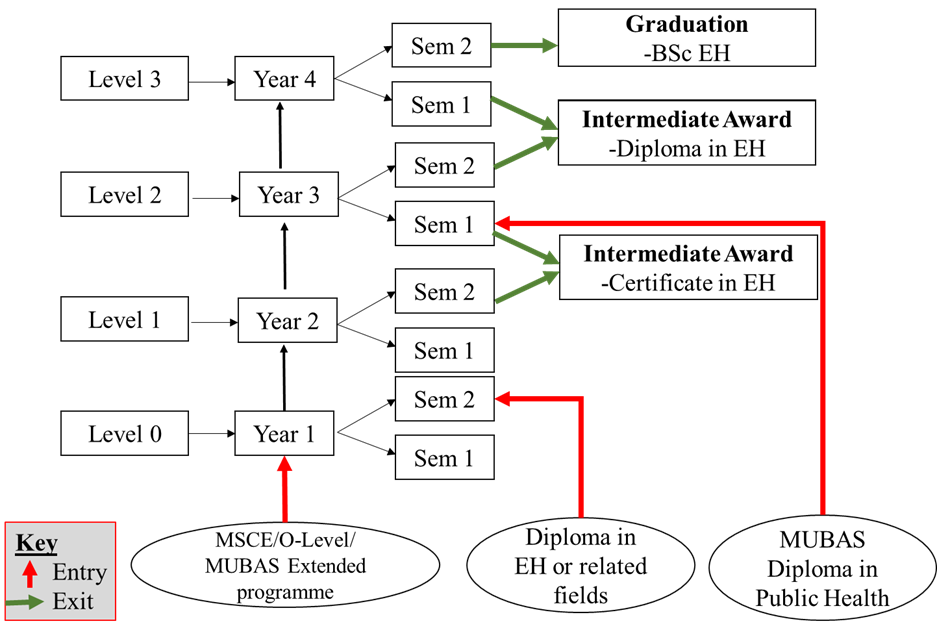
Figure 1: Triple-Entry and Triple-Exit Structure of BSc Environmental Health
Selection Criteria
Selection of applicants will be based upon consideration of an individual’s academic qualification, and, in case of mature entry candidates, work experience. Entry to the programme will be open to applicants who conform to the following criteria:
Normal Entry Candidate:
- Six MSCE/O-Level credits including English, Mathematics, Biology, Physics and Chemistry.
- Successful completion of MUBAS extended program
Mature Entry Candidate:
- Diploma in Environmental Health from Malawi College of Health Sciences, or Diploma in Public Health from University of Malawi
- MSCE/O-Level with at least credit passes in English, Mathematics, Biology, Physics and Chemistry or General Science.
- At least 2 years relevant work experience
Programme Exits
Intermediate Award: Certificate in Environmental Health
A student who has accumulated at least 240 credits, and who cannot progress further on the programme, will be awarded an Intermediate Award: Certificate in Environmental Health (Figure 1).
Intermediate Award: Diploma in Environmental Health
A student who has accumulated at least 360 credits, and who cannot progress further on the programme, will be awarded an Intermediate Award: Diploma in Environmental Health (Figure 1).
Bachelor of Science Degree in Environmental Health
A student, who has accumulated at least 480 credits will be awarded a Bachelor of Science Degree in Environmental Health (Figure 1).
Programme Delivery
The programme will be delivered through the normal face to face MUBAS semester system.
MPhil/PhD in Occupational Safety and Health
Admission criteria
Candidates seeking admission to the first year of the PhD in Occupational Safety and Health must hold a Master’s degree in Occupational Safety and Health, Environmental Health or a related field. Those applying for MPhil should have a Bachelor of Science Degree or any related field with experience in conducting independent research. Additional admission requirements are outlined in the GPRH or the advertisement for postgraduate programs at MUBAS.
Programme structure
PhD is awarded to scholars who have carried out supervised original research work that has been judged to have significantly contributed to the body of knowledge in Occupational Safety and Health. The PhD student needs a thesis to be presented in a logical and scholarly manner and must convince their examiners that they have fully grasped all the concepts of Occupational Safety and Health within which the subject of their thesis falls. The candidate will develop the qualities and abilities to make informed judgments on intricate issues in Occupational Safety and Health and innovation in solving respective problems. This is a full research-based degree programme. All students are registered for PhD programme in the first year, and assigned first and second supervisors. The exact division of responsibility between the two supervisors is stipulated in the Postgraduate Handbook. In the first year, the student will take some modules including Research Methodology for self-academic enrichment that could help him/her in proposal development and the research stages. The thesis contributes 360 credits for the award of a PhD in Occupational Safety and Health. The research project stages are presented in Figure 1.
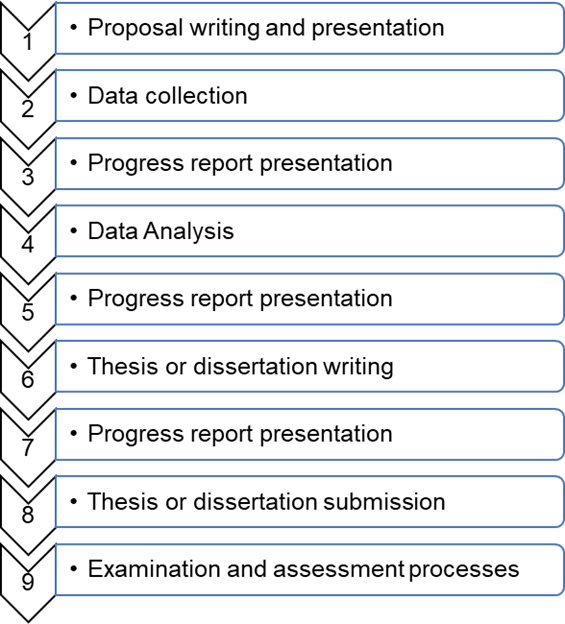
Figure 1: Research project stages
Preparation for the dissertation
The students are compelled to learn Research Methodology in the first year in preparations for their research work. The concepts learnt in Research Methodology culminate into a research proposal which is supposed to be defended prior to data collection. Refer to the guidelines in Postgraduate Handbook for details of thesis preparations.
Programme exits
On successful completion of the programme, students will be awarded a PhD in Occupational Safety and Health. A candidate has to accumulate a total of 360 credits. If the candidate has not completed the studies satisfactorily, due to various reasons, the candidate may be awarded an MPhil in Occupational Safety and Health upon satisfying conditions of the award.
Bachelor Of Science In Occupational Safety And Health
Admission Criteria
Normal Entry
A candidate with MSCE, ‘O’ Level or equivalent may join the programme at the beginning of year 1 or level 0. These should have at least six credits including English, Mathematics, Biology, Physics and Chemistry or Physical Science
Mature Entry
- A candidate with MSCE, ‘O’ Level or equivalent, field work experience and a qualification from a recognized institution, may join the programme at the beginning of year 2 (Semester 1).
- A candidate with MSCE, ‘O’ Level or equivalent and a MUBAS diploma in OSH may join the programme at the beginning of year 3 (Semester 1).
Programme Structure
The School of Science and Technology, Department of Public and Environmental Health Sciences at MUBAS proposes to introduce a BSc in Occupational Safety and Health (BOSH) programme. Occupational Safety and Health deals with safeguarding and promoting the health and welfare of all workers which include the following priority areas;
- Improving capacity for occupational safety and health management.
- Strengthening legal framework and infrastructure on occupational safety and health
- Improving occupational safety and health information and documentation
- Improving occupational safety and health promotion and safety and health culture
- Improving the mainstreaming of HIV/AIDS and occupational TB management.
BOSH students may be employed as Occupational Safety and Health officers and OSH inspectors. They research, develop, control and provide advice on OSH. They coordinate risk assessment procedures that provide guidance on how risks should be controlled in a workplace. They promote safety and health principles through enforcement of OSH Act and regulations.
The programme will enable students to gain skills and competences in the design, implementation and evaluation of occupational safety and health management systems. Furthermore, the programme includes an element of self-directed learning and reflective practice that provide an experience of independent knowledge acquisition and their application in problem solving activities.
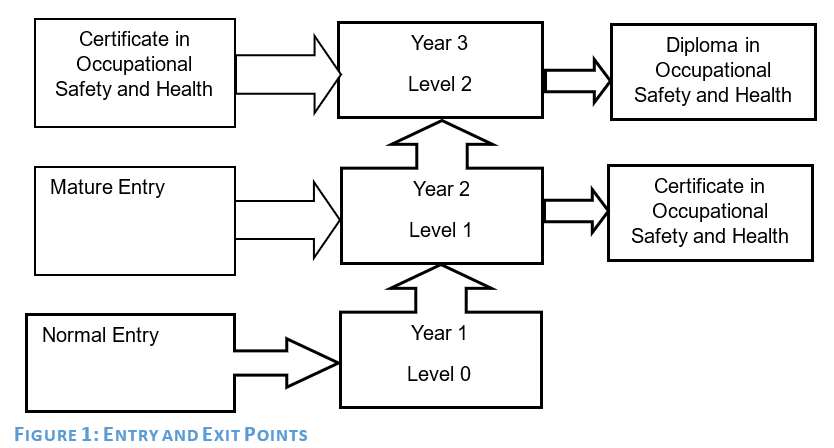
Students will be able to join the programme at level 0, level 1 and level 2 depending on previous qualifications and experience. It is also possible for a student to exit the programme and get an appropriate competence-level award.
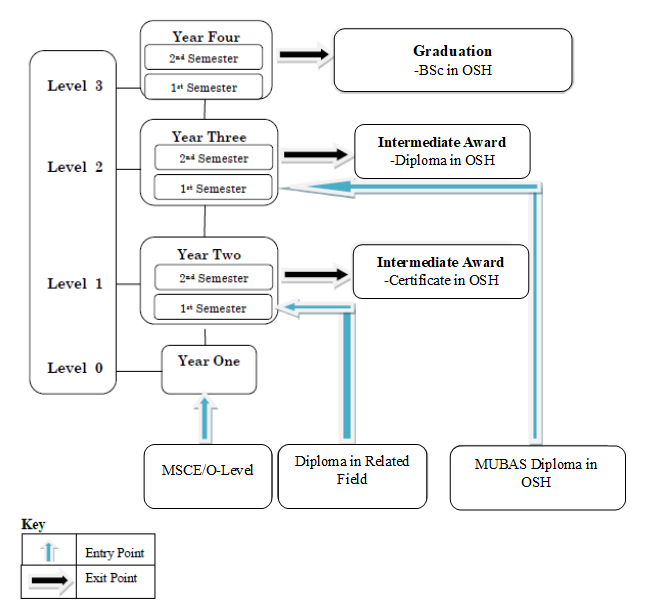
Figure 1: Triple-Entry and Triple-Exit Structure of BSc in Occupational Safety and Health
Programme Exits
Intermediate Award: Certificate in OSH
A student who has been credited with at least 240 credits, and who cannot progress further on the programme, will be awarded an Intermediate Award: Certificate in OSH.
Intermediate Award: Diploma in OSH
A student who has been credited with at least 360 credits, and who cannot progress further on the programme, will be awarded an Intermediate Award: Diploma in OSH.
Bachelor of Science Degree in OSH
A student, who has been credited with at least 480 credits will be awarded a Bachelor of Science Degree in OSH (Figure 1).
Diploma In Occupational Safety And Health
Admission Criteria
The admission requirement into the Dip OSH programme shall be:
Normal entry
- MSCE or O level with four credits including English, Mathematics, Biology, Chemistry and Physics or General Science.; or
- A-Level with at least a C in English, Biology, Chemistry or Physics.
Mature entry
- MSCE with four credits including English, Physical Science or General Science and Biology
- Minimum of two years working experience in related field and
- Any certificate in related field
Programme Structure
The programme will run for a period of three years (six semesters). The minimum number of credits a student may take per semester is 60. Thus, the minimum total number of credits required in the entire programme is 360 in semester two of year two students will go on attachment.
MPhil/PhD in Public Health Engineering
Admission Criteria
Candidates to be admitted into the first year of the PhD in Public Health Engineering should possess a Master’s degree in Public Health Engineering any related programme. Those applying for MPhil should have a BSc in Environmental Health, Public Health or Engineering related field from accredited institution. The other requirements are as stipulated in the GPRH or advert for postgraduate programmes at MUBAS.
Programme Structure
PhD is awarded to scholars who have carried out supervised original research work that has been judged to have significantly contributed to the body of knowledge in public health engineering. The PhD student needs a thesis to be presented in a logical and scholarly manner and must convince their examiners that they have fully grasped all the concepts of public health engineering within which the subject of their thesis falls. The candidate will develop the qualities and abilities to make informed judgments on intricate issues in public health engineering and innovation in solving respective problems. This is a full research-based degree programme. All students are registered for PhD programme in the first year, and assigned first and second supervisors. The exact division of responsibility between the two supervisors is stipulated in the Postgraduate Handbook. In the first year, the student will take some modules including Engineering for Public Health and Research Methodology for self-academic enrichment that could help him/her in proposal development and the research stages. The thesis contributes 360 credits for the award of a PhD in Public Health Engineering. The research project stages are presented in Figure 1.
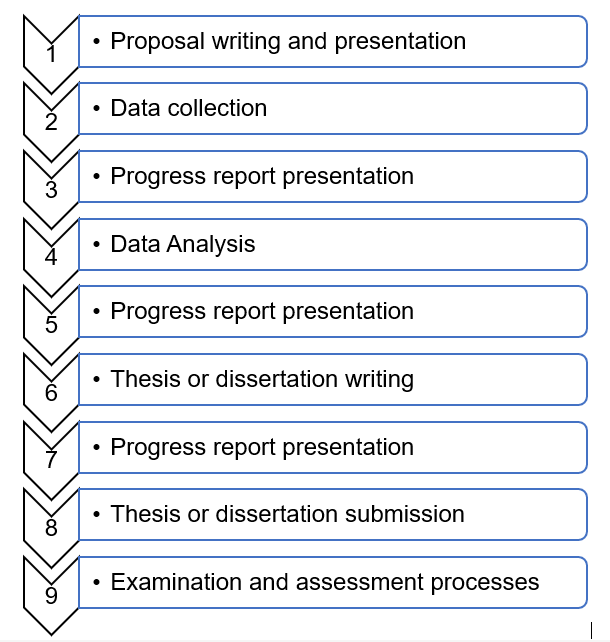
Figure 1: Research Project Stages
Preparation for the Thesis
The students are compelled to learn Research Methodology in the first year in preparations for their research work. The concepts learnt in Research Methodology culminate into a research proposal which is supposed to be defended prior to data collection. Refer to the guidelines in Postgraduate Handbook for details of thesis preparations.
Programme Exits
On successful completion of the programme, students will be awarded a PhD in Public Health Engineering. A candidate has to accumulate a total of 360 credits. If the candidate has not completed the studies satisfactorily, due to various reasons, the candidate may be awarded an MPhil in Public Health Engineering upon satisfying conditions of the award.